Pool Removal Los Angeles Rules by Permit Office: City of LA, LA County and Five Nearby Cities
Pool removal rules around Los Angeles range from drainage holes 12 inches across under LADBS to 24 inches under Los Angeles County AM J103 and 3 feet in Torrance, according to a November 2026 handout comparison by Pool Removal Directory CA.
Pool Removal Directory CA compared the published pool demolition handouts of LADBS, Los Angeles County Public Works, Torrance, Calabasas, Agoura Hills, Rancho Palos Verdes and Palos Verdes Estates side by side, document by document. The parcel address decides which handout applies, so a yard in Westchester and a yard in Torrance a few miles south follow different hole sizes, different wall removal depths and different records. LADBS Bulletin P/BC 2026-111 governs parcels inside City of Los Angeles limits. Los Angeles County Administrative Manual AM J103 governs many county-served parcels. Each of the five cities publishes its own demolition sheet with its own numbers.
Which Office Issues a Pool Removal Permit in Los Angeles?
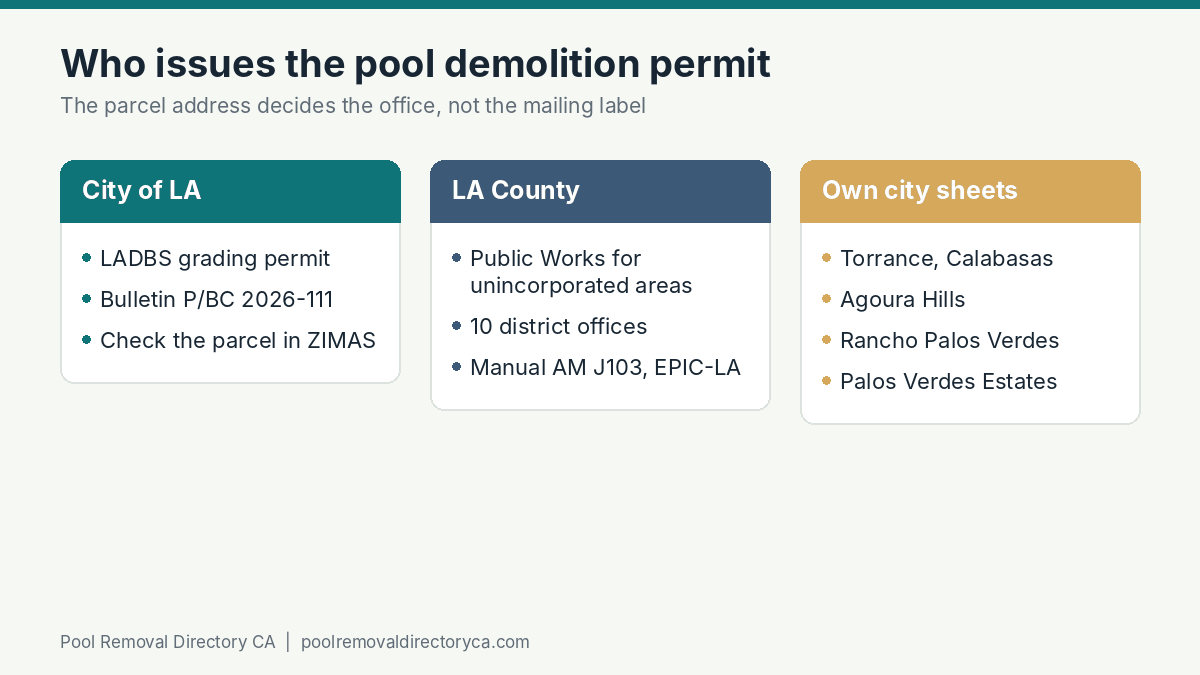
The parcel address picks the office: City of Los Angeles parcels go to LADBS, unincorporated parcels go to Los Angeles County Public Works, and 9 County city offices serve contract cities.
ZIMAS, the City of Los Angeles parcel map at zimas.lacity.org, confirms whether an address sits inside city limits. Many addresses carry a Los Angeles mailing label while sitting in an independent city or in unincorporated county land. Owners in Altadena, East Los Angeles or Hacienda Heights deal with the County, not with LADBS. Owners in Burbank, Glendale, Pasadena, Santa Monica and Long Beach deal with their own city departments.
City of Los Angeles parcels
LADBS, the Los Angeles Department of Building and Safety at dbs.lacity.gov, issues a grading permit for every pool backfill inside city limits. The Grading Division reviews the compaction report on the Part II route. A city parcel in Encino, Silver Lake or San Pedro follows the same bulletin.
Unincorporated county parcels
Los Angeles County Public Works issues permits for unincorporated areas, according to the County permit portal at permits.lacounty.gov. The County lists 10 district offices for unincorporated communities. EPIC-LA is the County's online system for permits and inspections. The County building division home page sits at dpw.lacounty.gov.
Contract cities and independent departments
Some incorporated cities contract with the County for building services, and those cities follow County manuals such as AM J103. Other cities run their own building and safety divisions and publish their own pool demolition sheets. Torrance, Calabasas, Agoura Hills, Rancho Palos Verdes and Palos Verdes Estates each post a separate handout. The handouts share a basic shape, yet the measurements inside them differ in ways that change the quote.
City of Los Angeles: Bulletin P/BC 2026-111
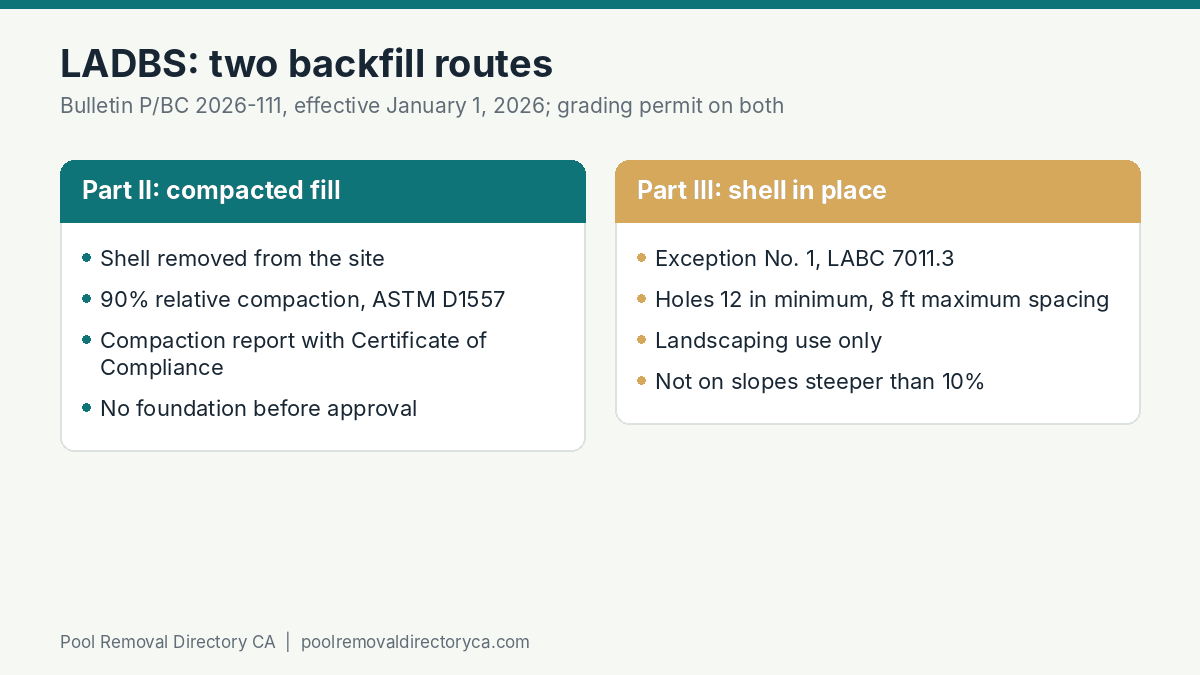
LADBS Bulletin P/BC 2026-111, titled Backfill of Swimming Pools, took effect on January 1, 2026 and replaced P/BC 2023-111. The LADBS backfill bulletin sets two routes and requires a grading permit on both. Part II of the bulletin removes the shell and places structural compacted fill. Part III leaves the shell in place with uncertified fill under Exception No. 1 of LABC Section 7011.3. The bulletin names the routes by part, not by letter.
Structural compacted fill under Part II
Part II fill reaches at least 90 percent relative compaction under ASTM D1557, the laboratory compaction test. A soil testing agency approved by LADBS tests the fill. The compaction report carries a Certificate of Compliance documenting the achieved densities. LADBS allows no foundation work until the Department approves that report.
Uncertified fill under Part III
Part III keeps the shell, punches drainage holes and backfills with clean soil or gravel. The backfill is moistened and compacted by tractor rolling or mechanical tamping. The plot plan shows the pool location, distances to all buildings and property lines, and a note that the fill is uncertified.
The backfilled area shall be used for landscaping purposes only.
LADBS states that limit in Part III of the bulletin. A patio slab, a garage or a guest house over a Part III pool is outside that limit.
Hillside and slope limits
LADBS bars the Part III route where the pool sits on ground steeper than 10 percent. Steep lots follow Part II instead. Part II on a site inside a Hillside Grading Area adds a Grading Pre-Inspection report. LADBS can also ask for a soils report from a licensed soils engineer with bearing pressures for foundation design.
Los Angeles County Manual AM J103
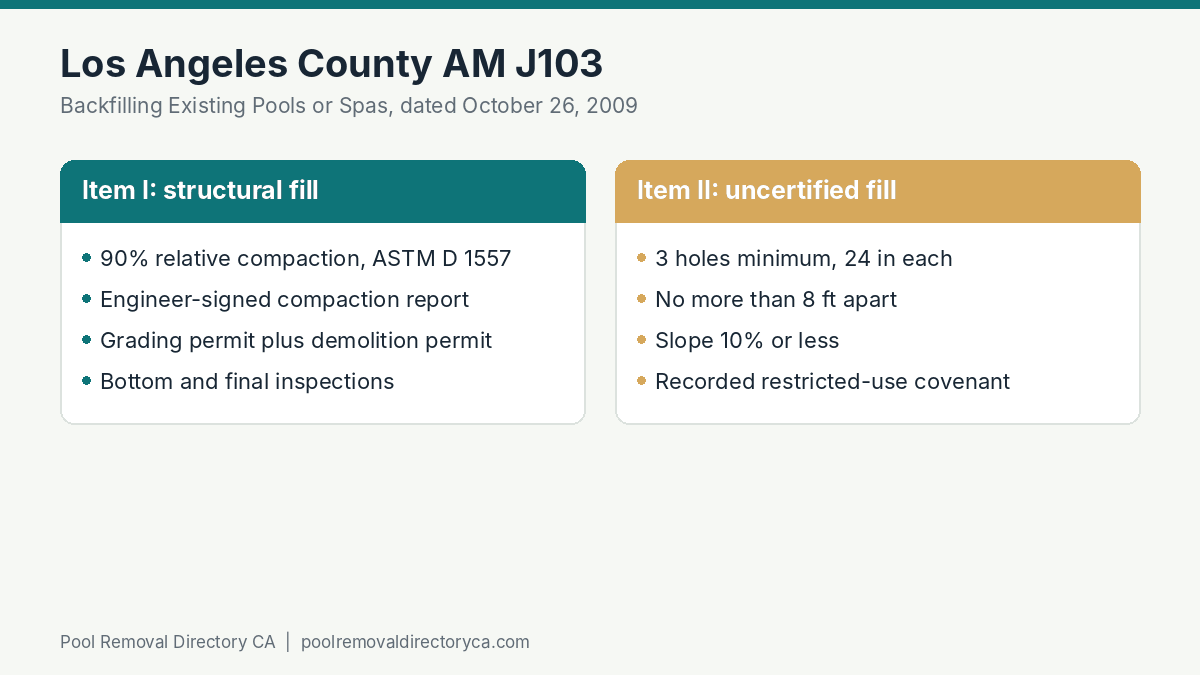
Los Angeles County Administrative Manual AM J103, which covers backfilling existing pools and spas, is dated October 26, 2009 and is posted by La Cañada Flintridge as a County backfill requirements sheet. AM J103 follows the same two-route idea as LADBS. The numbers inside it are stricter on the shell-in-place side.
Structural compacted fill under Item I
Item I calls for at least 90 percent relative compaction under ASTM D 1557, tested by an accredited agency that Building and Safety approves. A licensed civil or geotechnical engineer signs the final compaction report. The County issues a grading permit and a separate demolition permit, and the manual says the demolition permit exists for tax assessment purposes. Building and Safety inspects the excavation bottom and the final grade.
Uncertified fill under Item II
Item II allows the shell to stay only in a self-contained area that will not support buildings or structures. Ground slope cannot exceed 10 percent. The shell needs at least three drainage holes, each at least 24 inches in diameter, no more than 8 feet apart, with one in the deepest section. Bond beam concrete debris may go in the pool bottom, and the manual also limits which debris may sit in the drainage holes.
Recorded covenant
AM J103 requires a Covenant for a Restricted Use Area before the County issues any demolition or grading permit on the Item II route. The covenant binds every later owner. The restriction stays until the Building Official releases it with evidence that it is no longer needed. LADBS also publishes Form PC-STR.Mod 44, a modification request titled Fill Existing Pool in Lieu of Removing Pool Shell, which carries a recorded covenant and $255.06 in listed fees.
How Big Are the Drainage Holes in Each City?
Hole rules run from 12-inch holes no more than 8 feet apart under LADBS to two holes of 3 feet by 3 feet in Torrance and Rancho Palos Verdes.
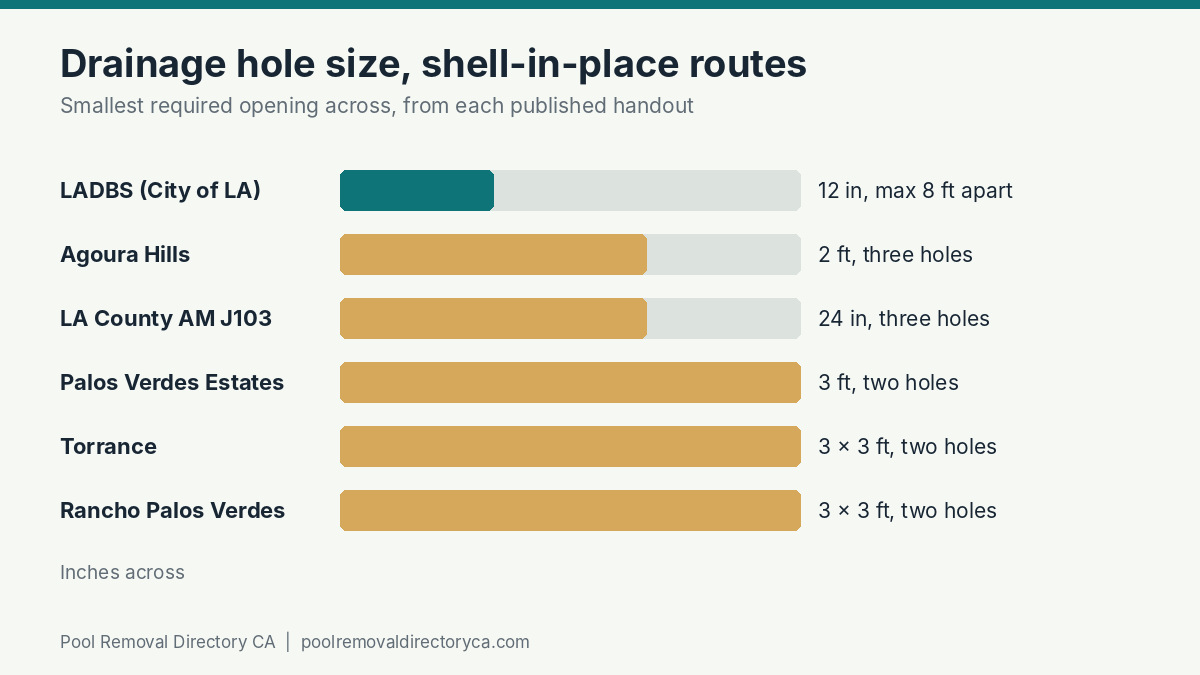
Drainage holes keep rain and irrigation water from collecting inside a buried shell. A shell without enough openings acts like a basin, and soft wet fill settles. The hole rules are where the seven handouts differ most.
Torrance
Torrance Building and Safety, in guidelines dated March 4, 2021 on torranceca.gov, calls for two holes at least 3 feet by 3 feet in the pool bottom. One hole sits in the deep end and one in the shallow end. An inspector checks the holes before any fill goes in. The fill is sandy soil compacted in 6-inch layers.
Rancho Palos Verdes
Rancho Palos Verdes requires at least two 3-foot by 3-foot holes, according to its pool demolition process sheet on rpvca.gov. A California licensed soils engineer or registered geotechnical engineer monitors backfill placement and compaction. A backfill compaction memo or report is due before the final inspection.
Palos Verdes Estates
Palos Verdes Estates requires two 3-foot holes, one at the shallow end and one at the deep end, according to its city requirements sheet on pvestates.org. A 1-foot layer of three-quarter-inch rock goes in first, with soil fill on top. A geotechnical engineer approves drainage in a memo.
Agoura Hills
Agoura Hills Building and Safety, in handout OP-06 dated March 1, 2023, listed on the city guides and handouts page, calls for three holes at least 2 feet in diameter in a pool and one in a spa. At least 12 inches of #4 rock covers the holes and the shell bottom. Debris pieces cannot exceed 3 inches.
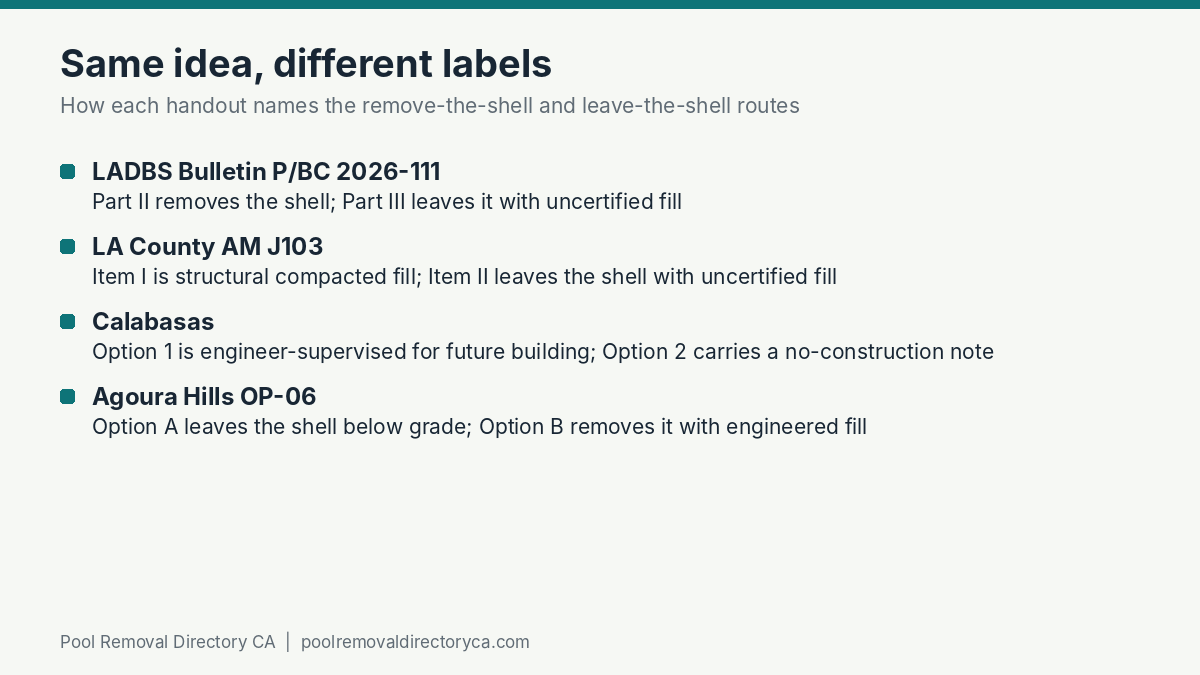
Route labels differ from handout to handout. Agoura Hills Option A leaves the shell below grade, while Calabasas Option 1 is the engineer-supervised route for sites that may get a structure later. AM J103 uses Item I and Item II, and LADBS uses Part II and Part III. A quote that names only a letter or a number leaves the route unclear, so owners comparing quotes across cities read the route description itself.
Fill material rules
Fill rules vary as much as hole rules. LADBS allows clean soil or gravel on the Part III route, moistened and compacted by tractor rolling or tamping. AM J103 also allows clean soil or gravel and permits broken bond beam concrete in the pool bottom. Torrance calls for sandy soil placed in 6-inch layers. Agoura Hills accepts self-compacting fill, Type SE25 sand or clean fill dirt over its rock layer, and it caps debris at 3 inches. Calabasas defines clean fill as inert material such as soil, rock, gravel, sand or separated concrete, and it bars painted materials.
Agoura Hills adds a lift limit on its Option B route, placing fill in lifts of no more than 8 inches under a geotechnical engineer. Palos Verdes Estates approves 90 percent compaction through geotechnical memos.
Inspection counts by office
LADBS schedules three inspections on both routes: an initial meeting, a bottom inspection and a final inspection. AM J103 lists a bottom inspection and a final inspection. Agoura Hills sets a minimum of two, a removal inspection and a final. Palos Verdes Estates inspects at the bond beam stage and again after backfill. Torrance inspects the holes before fill and expects a call when the work is complete. Rancho Palos Verdes checks drainage holes, partial wall removal, utility disconnects and the finished fill.
LADBS, AM J103, Torrance and Calabasas each state that the bottom, the holes or the site is inspected before any backfill goes in.
Wall and Bond Beam Removal Depths
The five city sheets each set a depth for removing the top of the pool wall, the bond beam or the coping on shell-in-place routes. Removal depth decides how much soil sits over the remaining concrete and how deep a later planting bed can go.
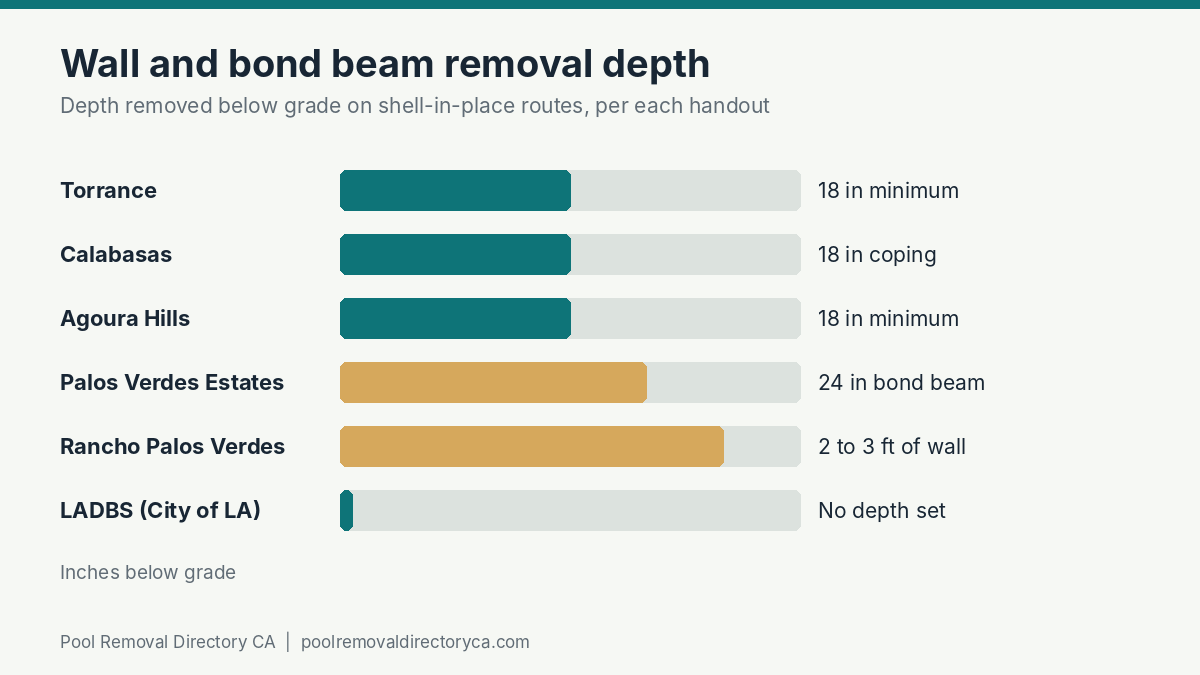
- Torrance removes the bond beam, gunite and all improvements to a minimum depth of 18 inches.
- Calabasas removes coping to at least 18 inches below finished grade, according to its pool demolition form on cityofcalabasas.com.
- Agoura Hills removes coping, bond beam and perimeter rebar to at least 18 inches below grade.
- Palos Verdes Estates removes 24 inches of bond beam, with a city inspection at that stage.
- Rancho Palos Verdes removes the upper 2 to 3 feet of the pool wall and hauls it offsite.
LADBS Bulletin P/BC 2026-111 sets no wall removal depth for Part III, and AM J103 sets none for Item II. The LADBS bulletin focuses on hole size, hole spacing, fill type and the landscaping limit. Owners in the city confirm the removal depth in the contractor's written scope before work starts.
Pool water and utility disconnects
Agoura Hills allows dechlorinated pool water to drain on site by percolation or into the storm drain, but it bars cleaning wastewater and filter backwash. Contaminated or chlorinated water goes to an approved containment facility. Agoura Hills also requires the gas line capped at the meter and at the equipment, and the electrical sub-panel removed back to the service supply. Rancho Palos Verdes requires all plumbing and electrical disconnected before its inspection. Palos Verdes Estates asks for all utilities cut and capped and for dump receipts covering rubble and utility debris.
DigAlert marking through 811 comes before excavation. AM J103, Agoura Hills, Rancho Palos Verdes and Palos Verdes Estates each address utility disconnection in their handouts.
When Does a Grading or Haul Permit Apply?
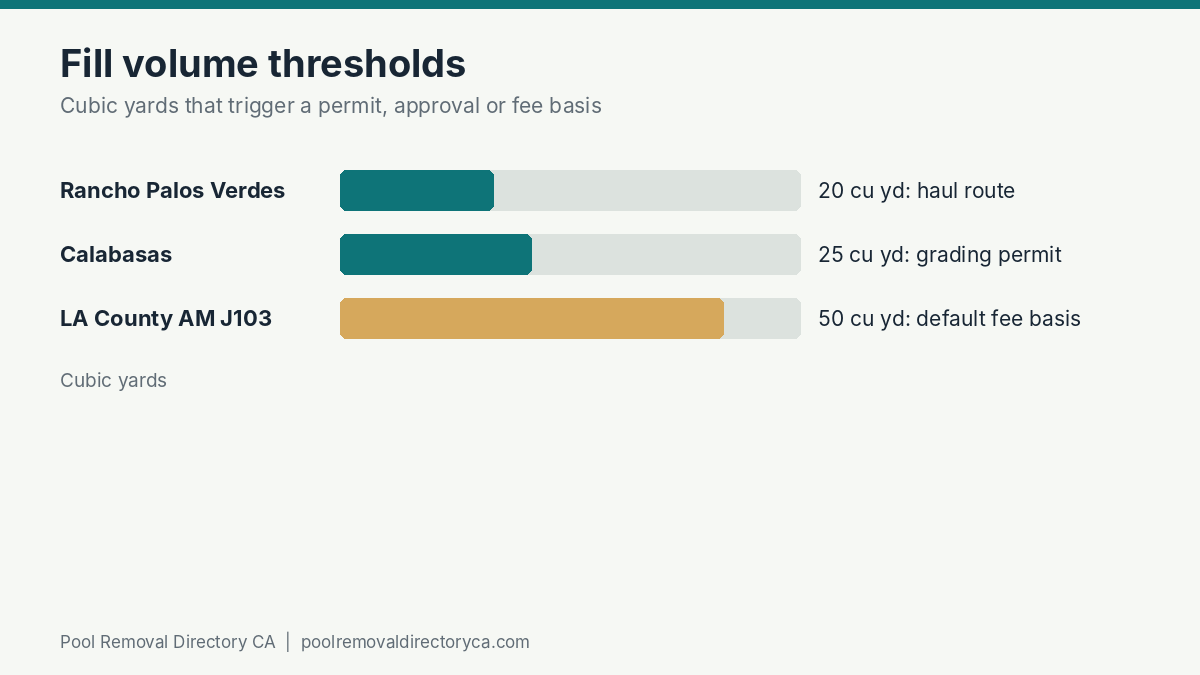
Thresholds differ: Calabasas requires a grading permit when a full shell comes out and fill exceeds 25 yards, and Rancho Palos Verdes requires haul route approval at about 20 cubic yards of imported dirt.
Fill volume and fees
LADBS requires a grading permit on both routes, and the Part II permit specifies the total cubic yards of fill. AM J103 bases the County grading fee on total cubic yards with no plan check fee. When the fill volume is unknown, the County charges as if the job used 50 cubic yards.
Haul routes and the public right-of-way
Rancho Palos Verdes runs pool demolition through three divisions. Planning takes a Minor Grading Permit application, Public Works approves the haul route, and Building and Safety takes two site plans stamped by both. Calabasas bans stockpiling demolition or fill material in the city right-of-way and requires a separate encroachment permit for any work there. Agoura Hills bars backfill storage on public streets without an encroachment permit.
What Records Follow the Property After Backfill?
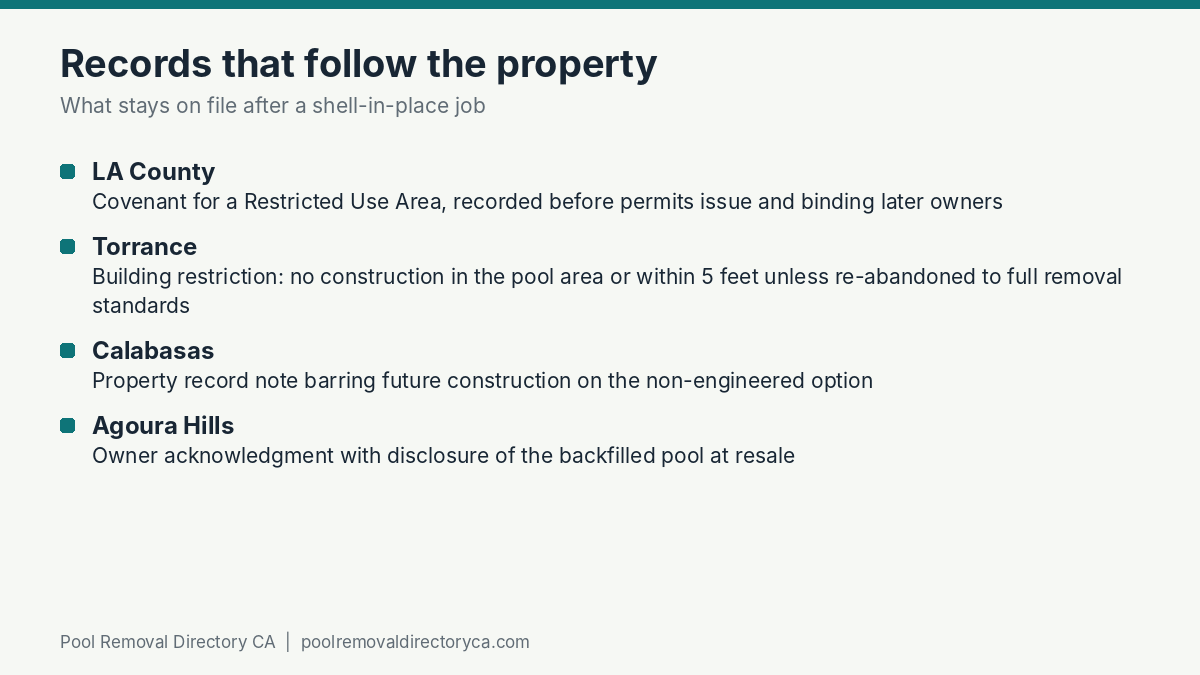
A shell-in-place job usually leaves a lasting record: a recorded covenant under AM J103, a building restriction in Torrance within 5 feet of the pool, or a no-construction note in Calabasas.
Restrictions on later building
Torrance places a building restriction on abandoned-in-place pools that bars construction in the pool area or within 5 feet of it. A later owner lifts the restriction only by re-abandoning the pool to full removal standards. Calabasas adds the note "No future construction will be allowed on this site" to the property record on its non-engineered option. Torrance also requires full removal whenever a building is planned over the pool or within 5 feet of it.
Disclosure at resale
Agoura Hills asks the owner to sign an acknowledgment for its shell-in-place route. The owner accepts possible differential settlement and agrees that no structure, deck, patio or driveway goes over the area. The form also commits the owner to disclose the backfilled pool, its size and its location when the property sells.
LADBS requires the Part III grading permit to include a plot plan that clearly marks the fill as uncertified.
Common misreadings
Four misreadings follow from the differences above. A Los Angeles mailing address does not place a parcel under LADBS; ZIMAS or the County locator settles it. A route letter or number does not mean the same thing in every handout, as the Agoura Hills and Calabasas labels show. A slope under 10 percent does not by itself qualify a pool for the shell-in-place route, because LADBS and AM J103 also limit the area to landscaping. A finaled shell-in-place permit does not clear the area for a later garage, room addition or pool house, because the landscaping limit or the recorded restriction still applies.
Cost Effects of the Route Choice
Permit office rules can shift the cost through engineering, testing and haul work. A rock layer, larger holes or a geotechnical memo is extra scope on the quote.
Published price ranges
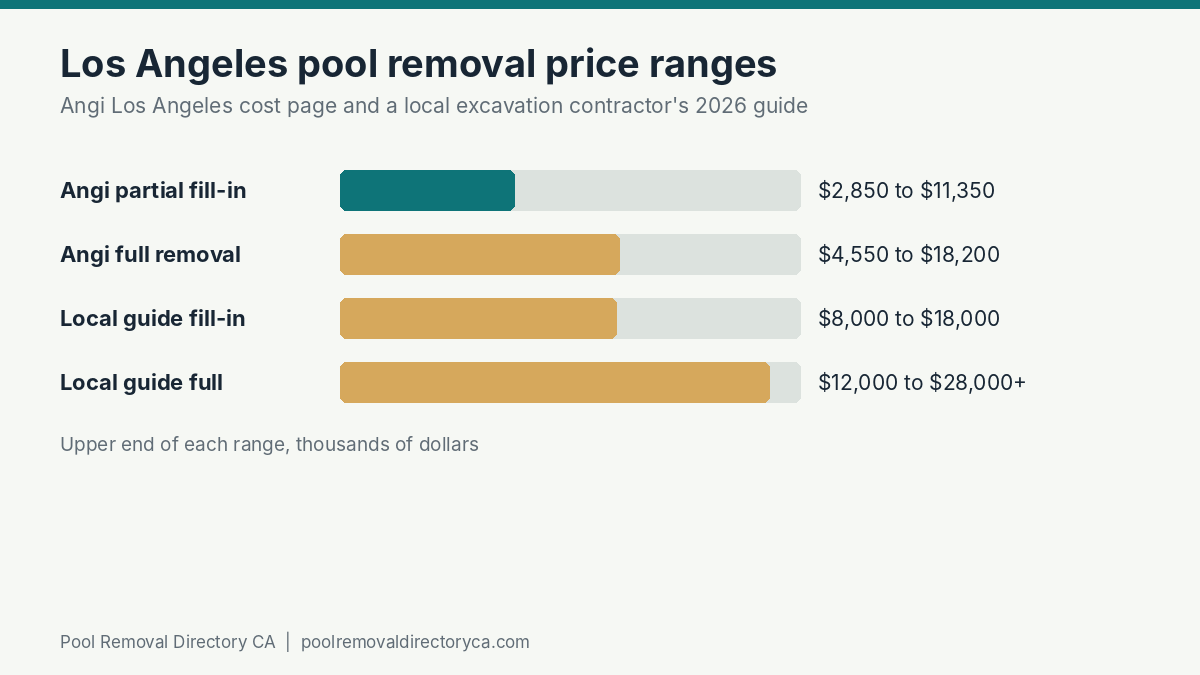
Angi's Los Angeles pool removal cost page puts the average at $6,816. Angi lists full removal at $4,550 to $18,200 and partial fill-in at $2,850 to $11,350. A local excavation contractor's 2026 guide reports partial fill-in at $8,000 to $18,000 and full removal with engineered, compaction-tested backfill at $12,000 to $28,000 or more.
What moves a quote within a range
The local guide notes that full removal commonly runs 30 to 60 percent above a comparable fill-in. Tight side-yard access, oversized decks and long haul routes push totals up. A Rancho Palos Verdes job adds a soils engineer on every pool. A Palos Verdes Estates job adds a rock layer and dump receipts for rubble.
Terms on Pool Demolition Handouts
The seven handouts use overlapping vocabulary. The definitions below summarize how the documents use each term.
- Bond beam
- The thick concrete band at the top of the pool wall under the coping. The five city sheets each set a depth for removing it or the wall above it on shell-in-place routes.
- Structural compacted fill
- Fill tested to at least 90 percent relative compaction under ASTM D1557 and documented in an approved compaction report.
- Uncertified fill
- Clean soil or gravel placed over a shell left in place. The area stays limited to landscaping or open space.
- Covenant for a Restricted Use Area
- A recorded County document that keeps future construction off an uncertified fill area until the Building Official releases it.
- Grading Pre-Inspection report
- An LADBS report required on the Part II route when the site sits inside a Hillside Grading Area.
Documents gathered before an application
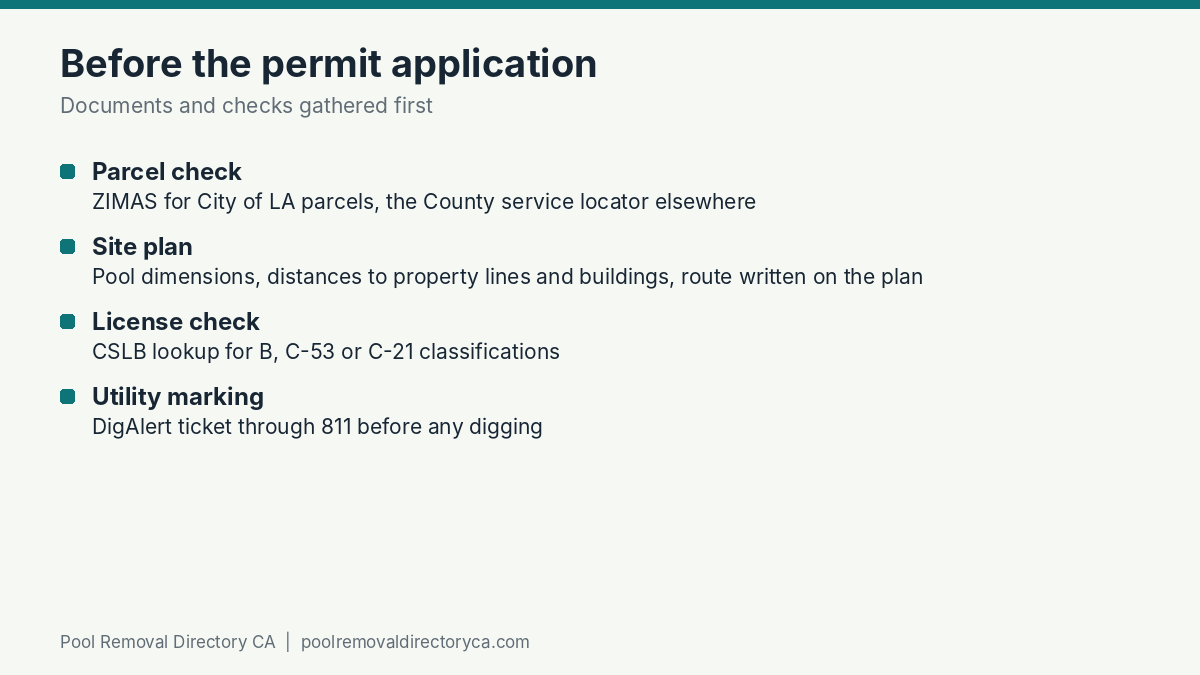
- A parcel check in ZIMAS or the County service locator to confirm the permit office.
- A site plan with pool dimensions and distances to property lines and buildings.
- A route choice written on the plan, certified fill or shell in place.
- A license check at the Contractors State License Board for the demolition contractor.
- A DigAlert ticket through digalert.org or 811 before any digging.
Agoura Hills accepts applications from homeowners and from contractors holding a B general license, a C-53 swimming pool license or a C-21 demolition license. The CSLB lookup shows whether a license is active and which classifications it covers.
The video walkthrough
The video below walks through a City of Los Angeles pool demolition from permit to final inspection.
Where the directory fits
Pool Removal Directory CA is a referral directory, not a contractor. The directory's license-checked firm list shows firms working inside City of Los Angeles limits, each checked against CSLB records. For the directory's other California city pages, click here.
A stage-by-stage schedule for a City of Los Angeles job appears in a permit-to-final timeline, and a city permit overview sums up the LADBS process.
Source documents
- LADBS Information Bulletin P/BC 2026-111, Backfill of Swimming Pools
- Los Angeles County AM J103 pool and spa backfill requirements
- Torrance swimming pool demolition guidelines
- Calabasas pool demolition and abandonment form
- Rancho Palos Verdes pool demolition process
- Palos Verdes Estates pool demolition requirements
- Agoura Hills guides and handouts, including OP-06 pool demolition requirements
- LADBS Form PC-STR.Mod 44